What's the correlation between hygiene and poverty?
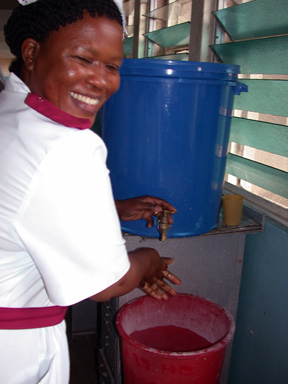
A health care worker demonstrates simple and effective hand-washing techniques.
"You can be extremely poor but extremely clean." If there ever was a statement that dispelled assumptions about the correlation between hygiene and poverty, it was this statement from Rwanda’s Minister for health in his opening remarks at a pro poor sanitation and hygiene workshop recently held in Kigali, Rwanda.
Poverty is usually associated with dirt and deprivation. It is often assumed that if one is poor, they are more unlikely to portray a clean, fresh appearance. In fact, coming to think of it, aren’t we always so ready to judge people’s socio-economic status by their appearance? Isn't the clean shaven man with well-manicured nails assumed to be of a higher economic status than the one whose physical appearance does not depict such attention to detail?
But is this really an assumption or a reality? Can one really be extremely poor but extremely clean? My opinion of the situation in Kenya is that people who lack basic hygiene and sanitation services such as clean piped water and personal toilets are more often those who live in informal settlements. Majority of the residents here cannot be classified as "rich;" if anything, they are the extreme opposite. Granted, hygiene is a very personal issue and must start with one’s realization of the effect of dirt on health and social relations. However, other influencing factors come into play.
Much as a poor person desires to be as clean as can be, it might be challenging when he lives in a one roomed shack with a wife, six children, no running water and a shared bathroom – and in this case, I am not referring to a bathroom shared with his family, but with hundreds of other residents living within the same radius. In many cases, there are no toilets (yes, you heard me right, no toilets at all)! So picture this, one answers a call of nature (use your imagination, but remember, there are no toilets!), and when he is done, has no hand washing facility or tap to do the needful….all because he couldn’t afford to live anywhere else.
The situation may be different in other parts of the continent and the world. But my take is that you don’t have to be extremely rich to be extremely clean, but if you are extremely poor, you are less likely to be extremely clean.
-- Turi Omollo, Communications Officer, PATH-Kenya
For more information:
-- Watch how Kenyans are working together to defeat diarrheal disease.
-- Can you imagine a house without a toilet? It's the reality of 2.6 billion people. With the right investment, access to sanitation stands to make an enormous impact.
-- Want to help spread the word about the water and sanitation crisis? Our toolkit will help get you started.
Photo credit: PATH
A health care worker demonstrates simple and effective hand-washing techniques.
"You can be extremely poor but extremely clean." If there ever was a statement that dispelled assumptions about the correlation between hygiene and poverty, it was this statement from Rwanda’s Minister for health in his opening remarks at a pro poor sanitation and hygiene workshop recently held in Kigali, Rwanda.
Poverty is usually associated with dirt and deprivation. It is often assumed that if one is poor, they are more unlikely to portray a clean, fresh appearance. In fact, coming to think of it, aren’t we always so ready to judge people’s socio-economic status by their appearance? Isn't the clean shaven man with well-manicured nails assumed to be of a higher economic status than the one whose physical appearance does not depict such attention to detail?
But is this really an assumption or a reality? Can one really be extremely poor but extremely clean? My opinion of the situation in Kenya is that people who lack basic hygiene and sanitation services such as clean piped water and personal toilets are more often those who live in informal settlements. Majority of the residents here cannot be classified as "rich;" if anything, they are the extreme opposite. Granted, hygiene is a very personal issue and must start with one’s realization of the effect of dirt on health and social relations. However, other influencing factors come into play.
Much as a poor person desires to be as clean as can be, it might be challenging when he lives in a one roomed shack with a wife, six children, no running water and a shared bathroom – and in this case, I am not referring to a bathroom shared with his family, but with hundreds of other residents living within the same radius. In many cases, there are no toilets (yes, you heard me right, no toilets at all)! So picture this, one answers a call of nature (use your imagination, but remember, there are no toilets!), and when he is done, has no hand washing facility or tap to do the needful….all because he couldn’t afford to live anywhere else.
The situation may be different in other parts of the continent and the world. But my take is that you don’t have to be extremely rich to be extremely clean, but if you are extremely poor, you are less likely to be extremely clean.
-- Turi Omollo, Communications Officer, PATH-Kenya
For more information:
-- Watch how Kenyans are working together to defeat diarrheal disease.
-- Can you imagine a house without a toilet? It's the reality of 2.6 billion people. With the right investment, access to sanitation stands to make an enormous impact.
-- Want to help spread the word about the water and sanitation crisis? Our toolkit will help get you started.
Photo credit: PATH

Breaking the correlation between diarrhea & poverty
Providing safe, reliable, piped-in water to every household in the world is the ideal goal. For the majority of people in the developing world the realization of this goal is still very far off. In the meantime, it is our responsibility to ensure that these families, whether they live in poverty-stricken areas or not, are empowered with tools to prevent and treat the diseases caused by living in unhygienic conditions.
Read more about how PSI tries to break this correlation between diarrheal diseases and poverty, by educating people and promoting hand washing, latrine use, safe water storage and the benefits of household treatment of drinking water: http://ow.ly/57Bnq
Submitted by Jyoti Kulangara, PSI
Post new comment